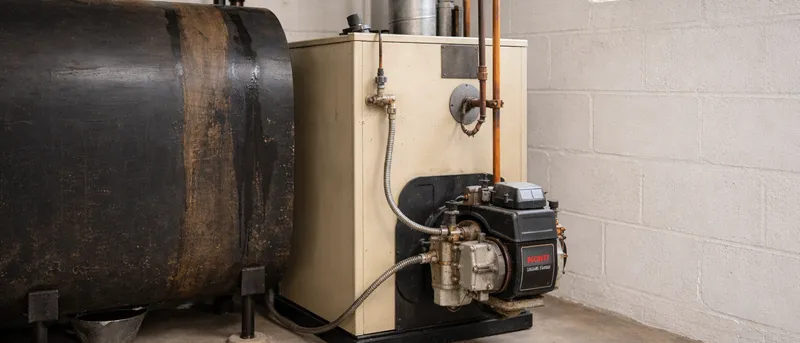
If you still heat your home with oil, you’ve probably heard about the Quebec government regulation phasing out this practice. But what exactly does the oil heating ban say? Is your equipment still legal? And what happens if your furnace or water heater breaks down this winter?
This guide answers those questions drawing directly from Quebec’s official government page — and helps you plan your transition before financial assistance runs out.
Why Quebec Is Phasing Out Oil Heating?
The Quebec government adopted a regulation on November 17, 2021, as part of its Green Economy Plan 2030. The goal: progressively eliminate residential oil heating across the province.
The reason is environmental and backed by data.
Oil emits 100 times more carbon than hydroelectricity. Residential oil heating generates approximately 1 million tonnes of CO2 per year — the equivalent of 300,000 light vehicles.
— Government of Quebec
About 200,000 Quebec households are directly affected. Heating accounts for more than 60% of residential energy consumption in Quebec — making it the most powerful lever available for reducing emissions.
Rules and Exceptions for Installation
The regulation introduces progressive prohibitions that apply based on building type and the nature of the work.
New Construction: A Complete Ban Since 2021
Since December 31, 2021, installing oil heating equipment in any new residential construction is prohibited. If you’re building or buying a newly built home, oil is no longer a legal option.
Existing Buildings: What’s Been Prohibited Since 2023
Since December 31, 2023, replacing an oil heating system with another fossil fuel system (oil, propane, natural gas) is prohibited in existing residential buildings of 600 m² or less and three stories or fewer — which covers the vast majority of Quebec bungalows, cottages, duplexes, and triplexes.
In practice: if your oil furnace is beyond repair or too old to be serviced, you cannot replace it with a new oil furnace. You must switch to electricity or a renewable energy source.
Repairs are still allowed, but with an important limit: only equipment less than 20 years old can be repaired (and less than 10 years old for water heaters). Beyond those thresholds, servicing with oil is no longer permitted.
Exceptions to the Regulation
Properties not connected to Hydro-Québec’s electrical grid — such as certain properties in the Îles-de-la-Madeleine and remote communities served by autonomous electricity networks — are not subject to the same restrictions. If your property falls in this category, verify your status through official Quebec government sources.
The Mandatory Removal Declaration
The regulation doesn’t only apply to homeowners — it also places obligations on the professionals who do the work.
Who Must File and How?
Any qualified professional who performs oil heating equipment removal must complete an online declaration with the Quebec government. Failure to comply can result in fines.
In practice: when you have your old system removed, make sure the contractor you hire — who must hold a valid Régie du bâtiment du Québec (RBQ) license to perform this work — is familiar with this obligation and complies with it.
Routine maintenance (regular servicing on equipment within the eligible age range) is exempt from the declaration requirement under Article 7 of the regulation.
Find an RBQ-certified heating contractor near you on Neat — certifications, reviews, and project history visible before you reach out.
How to Choose a New Heating System
If your system needs to be replaced, you’ll need to choose an alternative. Here are the key points to keep in mind, based on the Quebec government’s guidance.
Heat Pump, Electric Baseboards, or Electric Furnace: How to Compare Your Options
The heat pump is the most subsidized option and generally the most energy-efficient — even in Quebec winters. ENERGY STAR-certified models operate effectively at very low temperatures and combine heating and cooling in a single unit.
Electric baseboard heaters cost less to install but are more expensive to run over time. They work best for smaller spaces or as a supplementary heat source.
An electric furnace or boiler is an option if your home already has a compatible air or hot water distribution system.
Key precautions from the Quebec government:
- Never sign a contract on the spot with a door-to-door salesperson — no door-to-door solicitation is authorized under any government subsidy program
- Get multiple comparable quotes before making a decision
- Verify all information through official Quebec government sources
- Report any misleading claims to the Office de la protection du consommateur (OPC), Quebec’s consumer protection office
Financial Assistance Available for the Transition
Two provincial programs can be combined. A federal program is also available as an additional source of funding.
| Program | Organization | Max Amount | Eligible Work | Deadline |
|---|
| Chauffez Vert | Government of Quebec | $1,275 | Removal of oil or propane system + installation of an electric or renewable energy system | March 31, 2026 |
| LogisVert | Hydro-Québec | $6,700–$7,840 | Installation of an ENERGY STAR-certified heat pump | Ongoing |
| Oil-to-Heat Pump Affordability Program | Government of Canada | To verify | Conversion from oil heating to a heat pump | To verify |
Important notes:
- Chauffez Vert and LogisVert can be combined for the same project
- Total subsidies from all sources cannot exceed 80% of eligible expenses
- For Chauffez Vert: all work must be completed and the application received no later than March 31, 2026 at 11:59 p.m.
- For LogisVert: heat pumps installed on or after November 26, 2025 must be ENERGY STAR certified
Where to Start: Planning Your Transition
December is the best time to plan — before the spring contractor rush and before the Chauffez Vert program closes.
- Check your equipment’s age. If your furnace is 20 years or older (or your water heater is 10 years or older), oil-based repairs are no longer an option — a full transition is required.
- Get multiple quotes. Contact at least two or three contractors holding a valid RBQ license to compare options and pricing.
- Stack your subsidies. Submit a Chauffez Vert application before the March 31, 2026 deadline, and check your eligibility for LogisVert and the federal program.
- Confirm the removal declaration with your chosen contractor — they must file the online declaration form.
Conclusion
Quebec’s oil heating regulation is already in effect. If you’re still heating with oil, the question is no longer whether you’ll need to switch — it’s when, and under what financial conditions.
Acting now, before Chauffez Vert closes on March 31, 2026, gives you access to thousands of dollars in combined subsidies. Waiting for a breakdown means replacing your system under pressure, without assistance, at full cost.
Post your heating conversion project on Neat — specialized contractors respond directly. Compare offers, verify certifications, and act before the deadline.
Prefer to search yourself? Browse available heating contractors near you on Neat and reach out directly to the one that fits best.
Sources
- Government of Quebec — Regulation on oil heating appliances (adopted November 17, 2021); official page on rules, exceptions, removal declaration, and purchasing advice: quebec.ca/habitation-territoire/chauffage-consommation-energie/chauffage-mazout; environmental statistics (CO2 emissions, vehicle equivalents); Chauffez Vert program (up to $1,275, deadline March 31, 2026); $134.5M budget allocated to Chauffez Vert
- Hydro-Québec — LogisVert program: up to $6,700–$7,840 for ENERGY STAR-certified heat pump installation; stacking rules with Chauffez Vert
- Office de la protection du consommateur (OPC) — Warning against unauthorized door-to-door solicitation tied to heating subsidies