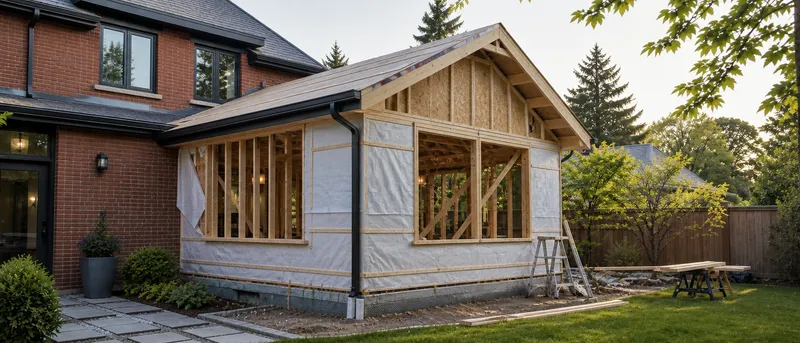
Property prices in Quebec have risen 67% over the past five years, according to the Association professionnelle des courtiers immobiliers du Québec (APCIQ). In 2026, the median price of a single-family home in the province is expected to reach around $520,200. If you’re weighing a home addition in Quebec — whether to make room for a growing family, a home office, or an aging parent — you may also be asking: is it smarter to add on or just buy something bigger?
The answer depends on your budget, your project, and your neighborhood. This guide gives you the numbers and the rules to make an informed decision.
Build an Addition vs. Buy: The Real Financial Question
Most homeowners underestimate the true cost of moving. Buying at $520,000 means paying Quebec’s land transfer tax (the “welcome tax”), notary fees, a home inspection, and a real estate commission of 4–5% on the sale of your current home.
Adding on means keeping your current mortgage rate, avoiding all those transaction costs — and staying in a neighborhood you already know. The trade-off: you’ll live through a construction project, and you’ll need a minimum of around $75,000 in 2026 for a standard addition.
| Criteria | Build an Addition | Buy a New Home |
|---|
| Base cost (2026) | $75,000–$300,000 | $520,000 (provincial median) |
| Transaction costs | Permit + plans (~$3,000–$5,000) | Notary + inspection + land transfer tax |
| Real estate commission | None | 4–5% of sale price |
| Mortgage rate | Preserved | Renegotiated at current rates |
| Living through construction | Yes | No |
| Neighborhood | Unchanged | New |
The bottom line: adding on pays off when the total project cost is less than the price gap between your current home and what you’d need to buy. In neighborhoods where prices have risen the most, that math often favors the addition.
Types of Home Additions: Which One Fits Your Project?
Costs and complexity vary significantly by project type. Here are the main options available in Quebec in 2026, based on data from RénoAssistance:
| Type of Addition | Turnkey Cost (2026) | Key Notes |
|---|
| Lateral extension on screw piles | $225–$270/sq ft | Light foundation, faster timeline |
| Lateral extension on slab/full foundation | $265–$310/sq ft | More solid, higher cost |
| Adding a full floor | $225–$270/sq ft | Requires structural assessment |
| 3-season sunroom | ~$250/sq ft (≈$36,000 for 144 sq ft) | Unheated — unusable in winter |
| 4-season sunroom | $258–$336/sq ft ($31,000–$48,000 for 144 sq ft) | Heated, fully insulated |
| Garage conversion | Varies | Existing structure reduces material costs |
| Basement finishing | ~$50/sq ft | The most affordable option |
| Adding a basement (house lift) | $150,000–$300,000 | The most expensive option |
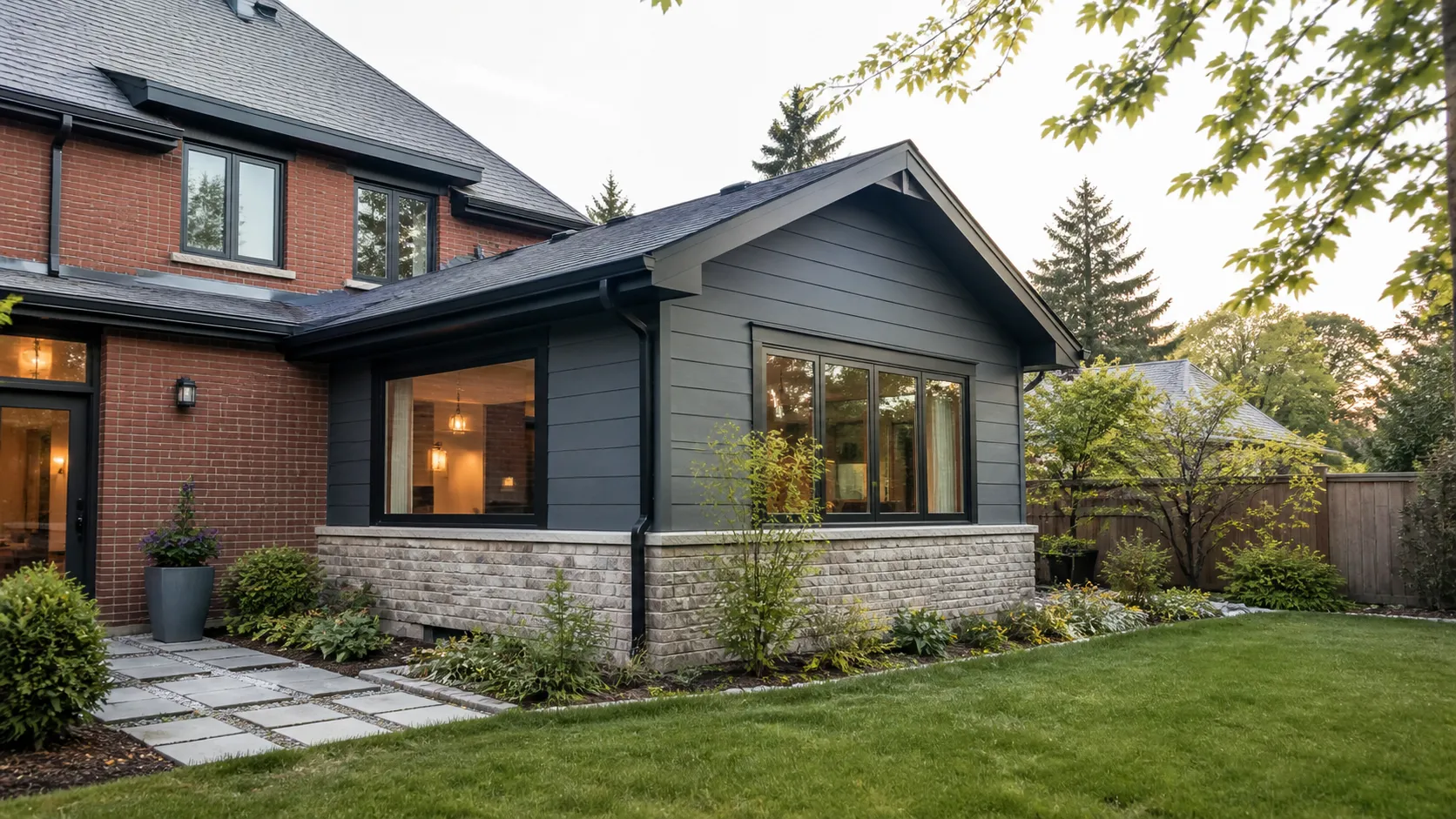 Image: Lateral extension on slab/full foundation
3-Season vs. 4-Season Sunroom
A 3-season sunroom sits on screw piles with no insulation — it cannot be used as a living space during a Quebec winter. A 4-season model includes full insulation (floor, walls, roof), a heating system, and high-performance windows. Since 85% of the surface is glass, window quality is the single biggest cost driver. Both types have a lifespan of around 25 years.
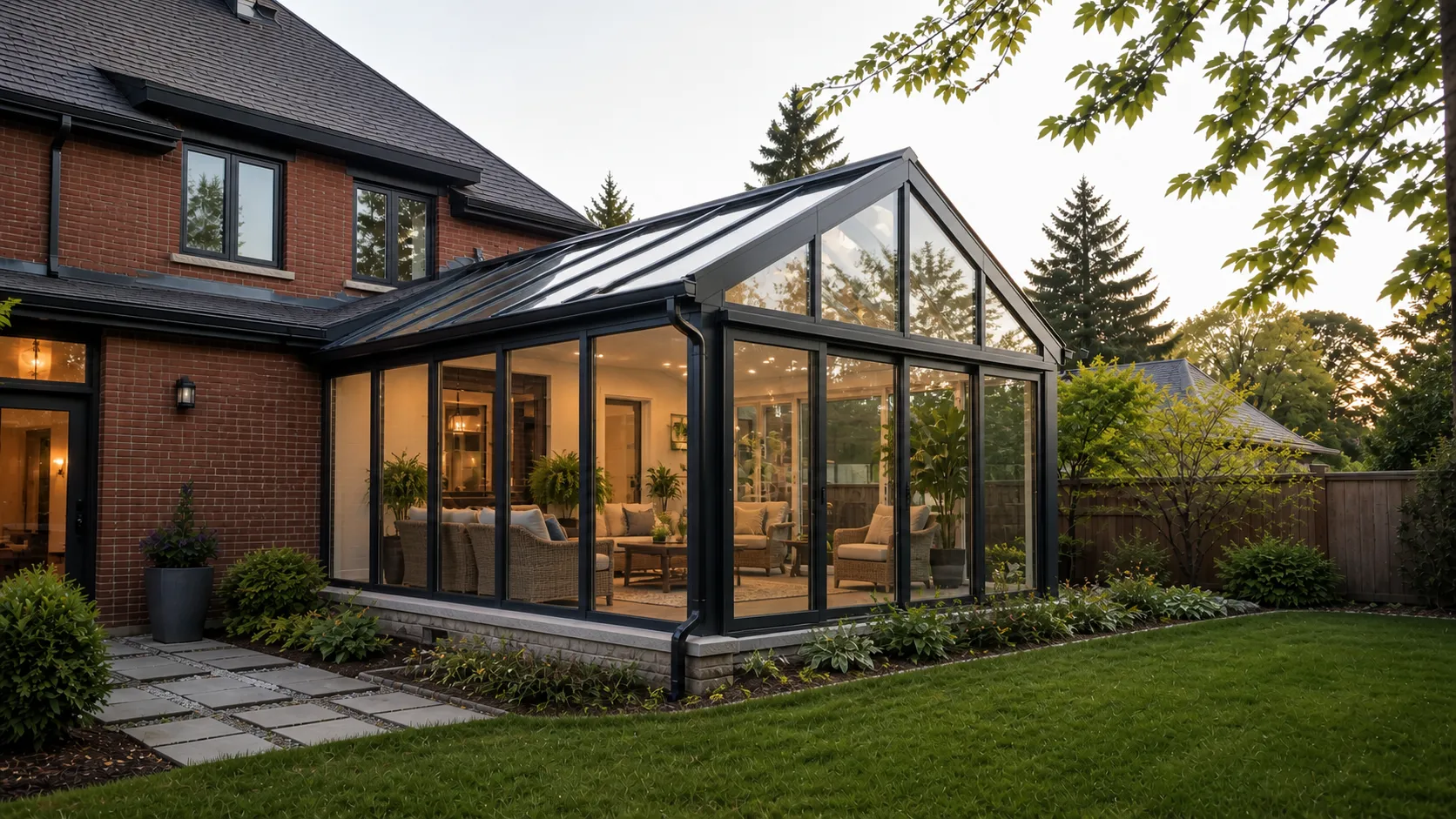 Image: 4-season sunroom
Garage Conversion
The existing structure helps cut material costs. That said, some municipalities prohibit removing front-yard parking — check with your local planning office before going this route.
Permits, Regulations, and Property Setbacks: What the Law Requires
Every home addition in Quebec requires a building permit issued by your municipality. The contractor must hold a valid license from the Régie du bâtiment du Québec (RBQ) — verify their license on the RBQ’s public registry before signing anything.
Any addition that increases floor area or adds a story is subject to Part 11 (Energy Efficiency) of the Building Code for residential buildings up to 600 m² and 3 stories or fewer.
— Régie du bâtiment du Québec (RBQ)
Property setbacks are defined by each municipality in its zoning bylaw and vary by zone and project type. As an example, one borough of Quebec City requires a 6.5 m front setback, 2.5 m at the rear, and 6 m on the sides. Your area may differ — confirm with your municipality before drawing up plans.
Required expenses to budget for beyond construction:
- Municipal permit: approximately $240
- Plans (technologist): $2,400–$3,600
- Plans (architect): 7–10% of total project value
Find an RBQ-certified contractor for your home addition on Neat
Which Addition Gives You the Best Return on Investment?
Some projects recover a larger share of their cost at resale. Here’s what RénoAssistance data shows for the Quebec market:
| Project | Estimated Cost | Estimated ROI |
|---|
| Kitchen renovation | $35,000–$45,000 | 75–100% |
| Bathroom renovation | $33,000–$38,000 | 75–100% |
| Basement finishing | $50,000–$55,000 | 50–75% |
| Attic conversion | $55,000–$60,000 | 50–75% |
| Secondary suite | $95,000–$110,000 | 50–75% |
| Outdoor living space (patio) | $8,000–$12,000 | 50–75% |
ROI depends as much on your local market as on the type of project you choose.
Common Mistakes That Cost You
- Starting without a permit — fines and mandatory demolition are possible
- Hiring a contractor without a valid RBQ license — you lose all legal protection if something goes wrong
- Ignoring property setbacks — a non-compliance issue found at final inspection can block your home sale
- Underestimating related costs — plans, permits, electrical and plumbing connections all add to the base quote
- Confusing 3-season and 4-season sunrooms — a 3-season unit cannot be used as living space through a Quebec winter
- Skipping the zoning check — some zones prohibit garage conversions or impose specific conditions
Ready to Move Forward?
A successful home addition starts with the right professionals. Get multiple quotes from certified contractors before committing — it’s the best way to compare prices, validate approaches, and protect your investment.
Post your home addition project on Neat — local contractors respond directly
Sources
- Association professionnelle des courtiers immobiliers du Québec (APCIQ) — real estate price statistics for Quebec (67% increase over five years, 2026 data)
- Royal LePage / Nesto — median property price projections for Quebec in 2026 ($520,200)
- Régie du bâtiment du Québec (RBQ) — contractor licensing, building permits, Part 11 of the Building Code, and heated sunroom regulations
- Gouvernement du Québec — municipal zoning bylaws, building permits, and property setback rules
- RénoAssistance — home addition costs by type, sunroom pricing, garage conversion data, and return-on-investment figures